

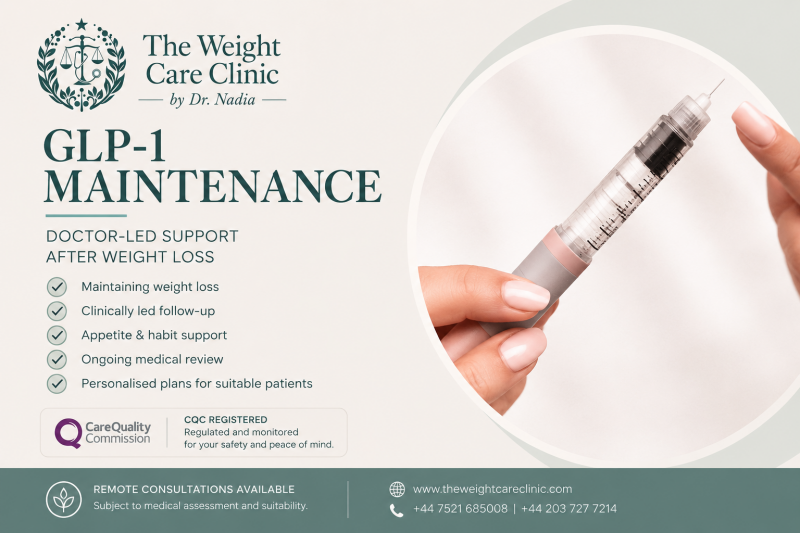
Reached your goal weight and wondering what comes next?
Learn how The Weight Care Clinic supports suitable patients with doctor-led weight loss maintenance and ongoing review.
For many people, reaching their goal weight is a huge achievement. It often comes after months of effort, lifestyle changes, and carefully managed treatment. But while the early stages of weight loss receive most of the attention, the next phase is just as important: maintenance.
This is the stage that many patients are not fully prepared for. What happens once you have reached your target? What kind of support is still available? And what do you do if an online pharmacy may no longer continue prescribing once your circumstances or eligibility criteria change?
These are the questions more patients are now asking, particularly as medical weight management becomes more widely used across the UK.
Why maintenance matters after weight loss
Losing weight is one part of the journey. Maintaining that progress is often the harder part.
Weight regain can happen for many reasons. Appetite may return more strongly. Motivation can shift once the original goal has been reached. Patients may feel less structured once they move beyond the active treatment phase. In some cases, they may also feel they have fewer support options than they expected.
That is why maintenance should not be treated as an afterthought. It should be seen as a planned stage of care, with proper review, realistic expectations, and individualised support.
A clinic-led approach can help patients think beyond short-term results and focus on what long-term success actually looks like. The Weight Care Clinic describes its service as doctor-led, CQC-registered, and fully remote, with personalised plans, medication management, and ongoing clinical support for patients across the UK.

The problem many patients face after reaching their goal weight
One of the biggest frustrations for patients is not always the weight loss itself. It is the uncertainty that follows.
Many people assume that once they have done well, support will simply continue in the same way. In reality, some providers may reassess whether treatment remains appropriate based on current criteria, prescribing policies, or clinical judgement. That can leave patients feeling unsure about what comes next.
This is where the difference between a transactional provider and a doctor-led clinic becomes important. A medically supervised service is usually better placed to look at the bigger picture, including progress so far, long-term goals, tolerability, and whether any ongoing treatment or follow-up remains clinically appropriate. The Weight Care Clinic states that its services include full medical oversight, ongoing support, and prescription treatment only where clinically appropriate.
What doctor-led maintenance support can offer
Maintenance support should never be reduced to a generic message of “just keep going.” For many patients, this phase benefits from professional input.
Doctor-led maintenance may include:
Ongoing medical review
Support with appetite and habits
Guidance around lifestyle and routine
Monitoring of side effects and tolerability where relevant
A more personalised plan based on progress and suitability
The Weight Care Clinic’s service pages describe a model that includes doctor-led eligibility assessment, monitoring, side-effect support, lifestyle guidance, and ongoing clinical supervision. Its terms also state that treatment is not guaranteed and that prescribing is based on a full medical assessment and clinical appropriateness.

Why patients may prefer a clinic rather than a pharmacy-only model
Patients often want more than a prescription. They want reassurance, continuity, and a proper conversation about what happens after the initial weight loss phase.
The Weight Care Clinic says its service is led by GMC-registered doctors and founded by Dr Nadia Ahmad, with clinical leadership that includes experience in family medicine, diabetes management, preventative medicine, and long-term condition care. The clinic also states that it is regulated by the Care Quality Commission and offers consultations remotely across the UK.
That kind of positioning may appeal to patients who do not want to feel as though they are navigating maintenance alone. It also gives a more reassuring framework for patients who want a service that looks at long-term wellbeing rather than only short-term weight loss.
Remote maintenance support can still be clinically robust
There is still a misconception among some patients that remote care is somehow less thorough. In reality, remote care can be highly effective when it is properly structured and medically supervised.
The Weight Care Clinic states that consultations take place by secure video call and that patients can access care from anywhere in the UK. It also presents itself as a remote clinic with regulated pharmacy partners and ongoing doctor-led support.
For many people, that is a major practical advantage. It can make follow-up easier to maintain, reduce travel, and offer a more discreet way to access ongoing review.
A more realistic conversation about long-term success
One reason maintenance matters so much is that it brings the conversation back to reality.
Short-term transformation stories are easy to market. Long-term weight management is more nuanced. It often requires adjustment, planning, review, and honesty about what sustainable progress actually looks like.
The Weight Care Clinic’s recent weight management content emphasises sustainable progress, safety, professionalism, and medically guided care rather than exaggerated claims. Its services page also explicitly says treatments are prescribed following full medical assessment and are not guaranteed.
That is the kind of tone more clinics should adopt. Patients deserve a realistic, medically responsible conversation about what happens after they reach their goal.

Who might consider maintenance support?
Maintenance support may be worth exploring for patients who:
Have reached their goal weight and want ongoing review.
Are concerned about regaining weight without structure.
Want doctor-led follow-up rather than navigating alone.
Need a more personalised next-step plan.
Are looking for remote, UK-wide support from a regulated clinic.
Any treatment or follow-up should always depend on medical assessment and suitability. The Weight Care Clinic states that prescribing decisions and care plans are subject to clinical review, and its wider service model includes ongoing support and monitoring where appropriate.
The Weight Care Clinic at a glance
Based on the clinic’s current website, The Weight Care Clinic presents itself as:
A doctor-led UK service
CQC-registered
Fully remote
Offering medical weight management, medication management, and ongoing clinical support
available to patients across the UK through remote consultation
Final thoughts
Reaching a goal weight is not the end of the conversation. For many patients, it is the point where a different kind of support becomes important.
Maintenance is about protecting progress, building confidence, and creating a realistic plan for the future. The strongest services are usually the ones that recognise this and offer proper follow-up rather than leaving patients to work it out alone.
The Weight Care Clinic positions itself as one of those services: doctor-led, CQC-registered, remote, and focused on personalised support with appropriate medical oversight. For patients wondering what happens after weight loss, that is a valuable model to understand.
Add comment
Comments